
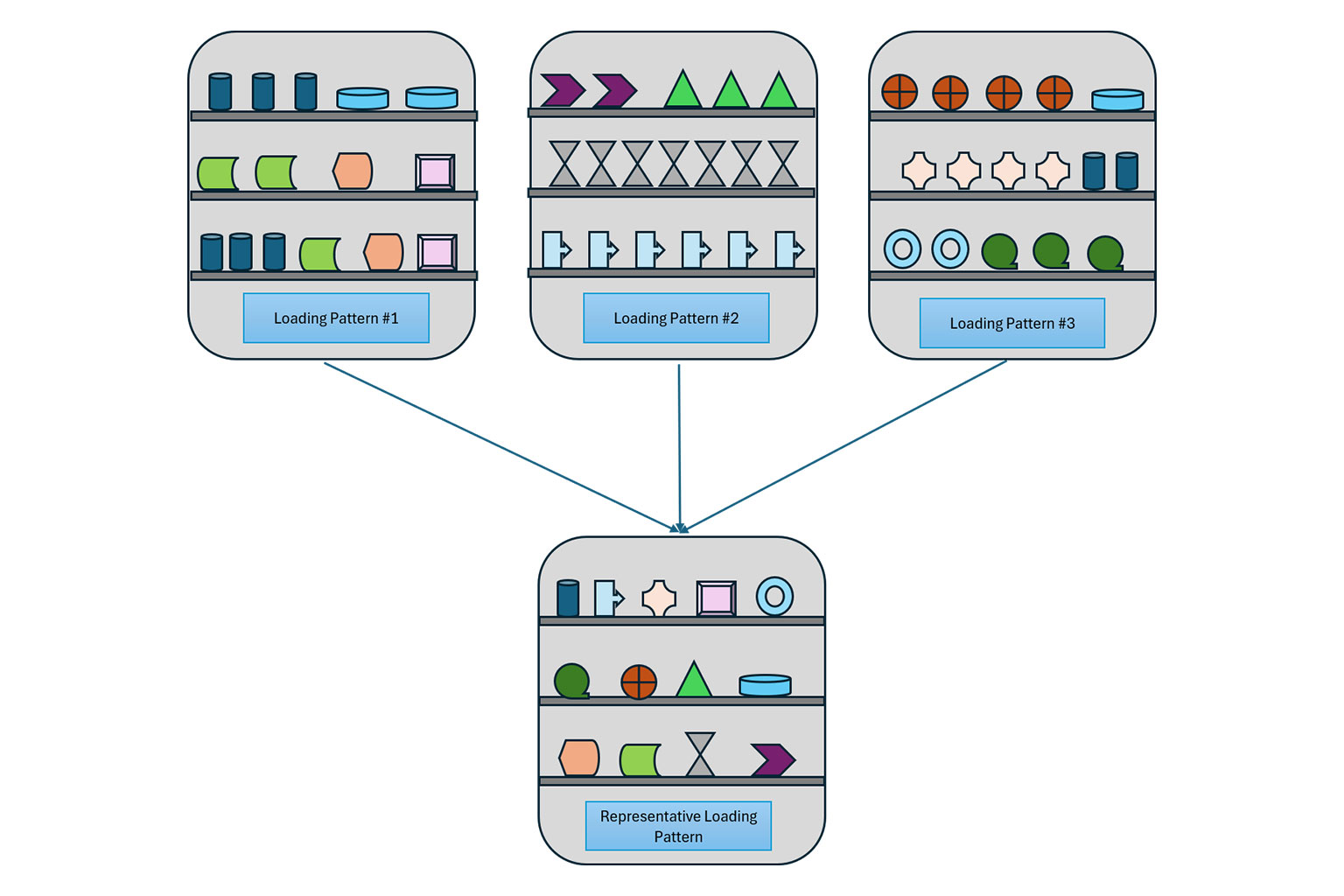
Validating each loading pattern individually creates a substantial workload. A single, scientifically justified representative load configuration can validate them all — fully compliant with Annex 1 and FDA requirements.
1. Introduction
In many facilities, multiple loading patterns are used to sterilize different solid items. In most cases, an overkill sterilization cycle is applied, and these loads frequently contain several identical or equivalent items.
The conservative and commonly applied approach is to validate each loading pattern individually. This typically involves performing three consecutive heat-penetration runs of the complete load configuration, followed by selection of the most challenging item to define a minimal load study, which also includes three consecutive heat-penetration runs. Thermocouples (TCs) and biological indicators (BIs) are placed in the most difficult-to-sterilize locations within selected items to demonstrate that the required sterilization conditions have been achieved.
As a result, validating each loading pattern individually creates a substantial workload. Conducting multiple six-run heat-penetration studies demands significant resources and can extend over several weeks or even months.
2. Objective
This article presents a methodology for validating multiple loading patterns that significantly reduces the validation workload, and explains the scientific basis supporting the approach.
3. The methodology
The methodology relies on a single representative loading pattern constructed from one representative item selected from each item type present across all loading patterns.
The approach is scientifically justified and risk-based, and maintains full compliance with applicable sterilization validation principles and regulatory requirements for the validation of multiple loading patterns.
The methodology is derived from an article by the author published in the PDA Journal of Pharmaceutical Science and Technology:
Ben-David, A. (2023). Flexible loading pattern approach in overkill steam sterilization based on the physical properties of steam and thermodynamics of sterilization. PDA Journal of Pharmaceutical Science and Technology, 77(3), 166–180. https://doi.org/10.5731/pdajpst.2021.012708
4. Scientific and Technical Rationale
4.1. Steam Sterilization Principles
Moist heat sterilization is based on saturated steam thermodynamics and physical principles. Under steady-state conditions, where residual air in the chamber is very low (~0.1%):
- Chamber pressure equilibrates according to Pascal’s law
- Saturation temperature is directly correlated to chamber pressure
- Uniform pressure results in uniform atmospheric temperature throughout the chamber
Steam sterilization efficacy is achieved through condensation of saturated steam on cooler surfaces. During condensation:
- Latent heat is released without a reduction in temperature, heating the item efficiently
- Continuous steam flow toward the surface occurs due to the significant volume reduction associated with condensation. The flow is self-regulated according to the energy demand of the item — colder items receive a greater steam influx
The sterilization hold phase is initiated only after the chamber drain sensor reaches the set-point temperature, indicating that the chamber atmosphere has reached thermal equilibrium.
4.2. Independence of Items Under Saturated Steam Conditions
Under saturated steam conditions:
- The chamber atmosphere provides uniform exposure conditions
- Thermal exposure of one item does not reduce or interfere with the exposure of another item
- Sterilization lethality is delivered independently to each item
Accordingly, items processed under one loading pattern will receive equivalent sterilization exposure when processed under another loading pattern, provided the same sterilization cycle is maintained.
4.3. Critical Determinants of Sterilization Performance
The primary technical challenge in steam sterilization is not chamber temperature uniformity, but steam penetration into the most difficult-to-access locations within an item. Penetration efficiency depends on:
4.3.1. Air Removal Performance
Air removal is a chamber-level function common to all items. While load composition may influence evacuation dynamics, a properly designed air-removal phase ensures effective removal of air across all qualified load configurations and supports adequate steam penetration to any load configuration.
4.3.2. Item-Specific Characteristics
The ability of steam to penetrate an item depends on:
- Internal void structure
- Geometry
- Porosity
- Packaging resistance
- Material composition
These characteristics are intrinsic to the item and independent of the presence of other items within the chamber.
4.4. Preconditions for Representative Loading Pattern Validation
The following conditions shall be met:
- Items are arranged to allow unrestricted air removal and steam access. No item obstructs evacuation or steam penetration to another
- The sterilization cycle parameters remain unchanged
- The sterilization cycle is an overkill cycle with sufficient lethality (F₀ values above 25 minutes), providing a substantial safety margin to accommodate foreseeable minor variations in load configuration — including positional differences between the validated representative loading pattern and routine production loading patterns
4.5. Summary
In moist heat sterilization, provided that the required preconditions are maintained, chamber conditions allow each item to undergo sterilization independently — without influence, or with only negligible influence, from other items placed in the chamber.
This permits validation of the sterilization performance of each item within any loading pattern, including as a single item, provided that the defined preconditions are maintained. Accordingly, this principle supports the validation of multiple loading patterns using a single representative loading pattern.
5. The process
- Identify all loading patterns that require validation
- Identify all specific item types included within the defined loading patterns
- Select the items to be included in the representative loading pattern, using one of the following approaches:
- Select one representative item from each item type included in the loading patterns
- Perform a documented assessment to identify the most challenging items from each loading pattern. The assessment shall be based on a written SOP defining the principles for identifying worst-case or more challenging items
- Arrange all selected representative items within the chamber. If chamber space is insufficient, the items may be distributed across two or more representative loading patterns
- Perform three consecutive qualification runs of the representative loading pattern or patterns, with each selected item equipped with a TC and a BI placed at the most challenging location. The position of each instrumented item within the load shall be documented. This loading pattern may be considered the maximum loading pattern
- Verify that all acceptance criteria are met, including maximum and minimum temperatures, sterilization phase time, lethality F₀ values, and equilibration time
- Based on the lethality results, identify the item or items that achieved the lowest F₀ value and use these to perform three minimum-cycle qualification runs
- The validated maximum and minimum loading patterns may be used for annual requalification. If more than one maximum load exists, they may be alternated in consecutive years
- Each of the originally defined loading patterns may then be used in routine production, provided they conform to the preconditions outlined in Section 4.4
- When required, new items may be validated as standalone items through three penetration runs and subsequently added to existing loading patterns if space permits, or incorporated into a new representative loading pattern
6. Regulatory Compliance
6.1. Regulatory Requirements
Annex 1, §8.38: Validated loading patterns should be established for all sterilisation processes and load patterns should be subject to periodic revalidation. Maximum and minimum loads should also be considered as part of the overall load validation strategy.
FDA — Guidance for Industry, Sterile Drug Products Produced by Aseptic Processing (cGMP IX, C, 1): The specific load configurations, as well as biological indicator and temperature sensor locations, should be documented in validation records. Batch production records should subsequently document adherence to the validated load patterns.
6.2. Compliance of the presented methodology
The common interpretation of both Annex 1 and FDA requirements is that each loading pattern must be validated exactly as routinely performed, and that no variation between validated and routine loading patterns is permitted.
The proposed methodology interprets these requirements differently — based on a scientifically justified and risk-based approach. Rather than validating every possible loading permutation, the method establishes a representative validated loading pattern that envelopes all equivalent configurations within a defined load configuration envelope.
| Regulatory Aspect | Representative Load Methodology — Compliance Explanation |
|---|---|
| Annex 1 — Validated loading patterns should be established for sterilisation processes | A representative loading pattern is defined, scientifically justified, and validated to encompass all equivalent loading patterns within the validated load configuration envelope |
| Annex 1 — Load patterns should be subject to periodic revalidation | Periodic revalidation is performed on the representative loading pattern, which envelopes all equivalent configurations within the validated scope |
| Annex 1 — Maximum and minimum loads should be considered in the validation strategy | Maximum and minimum load conditions are included as part of the methodology |
| FDA — Specific load configurations, BI and TC locations should be documented | The representative loading pattern is formally defined and documented. BI and TC locations are selected based on scientifically justified worst-case positions and recorded in validation documentation |
| FDA — Batch records should document adherence to validated load patterns | Routine loading configurations are defined in the operational SOP and must remain within the validated load configuration envelope. Batch records document adherence to the validated representative pattern or its justified equivalent configurations |
7. Conclusion
Validating multiple loading patterns through one scientifically justified representative load is not a shortcut — it is a more rigorous use of the same physical principles that govern saturated steam sterilization. The result is a validation strategy that consumes a fraction of the resources, remains fully compliant, and provides equally defensible scientific evidence of sterility assurance across every loading pattern in routine use.

