
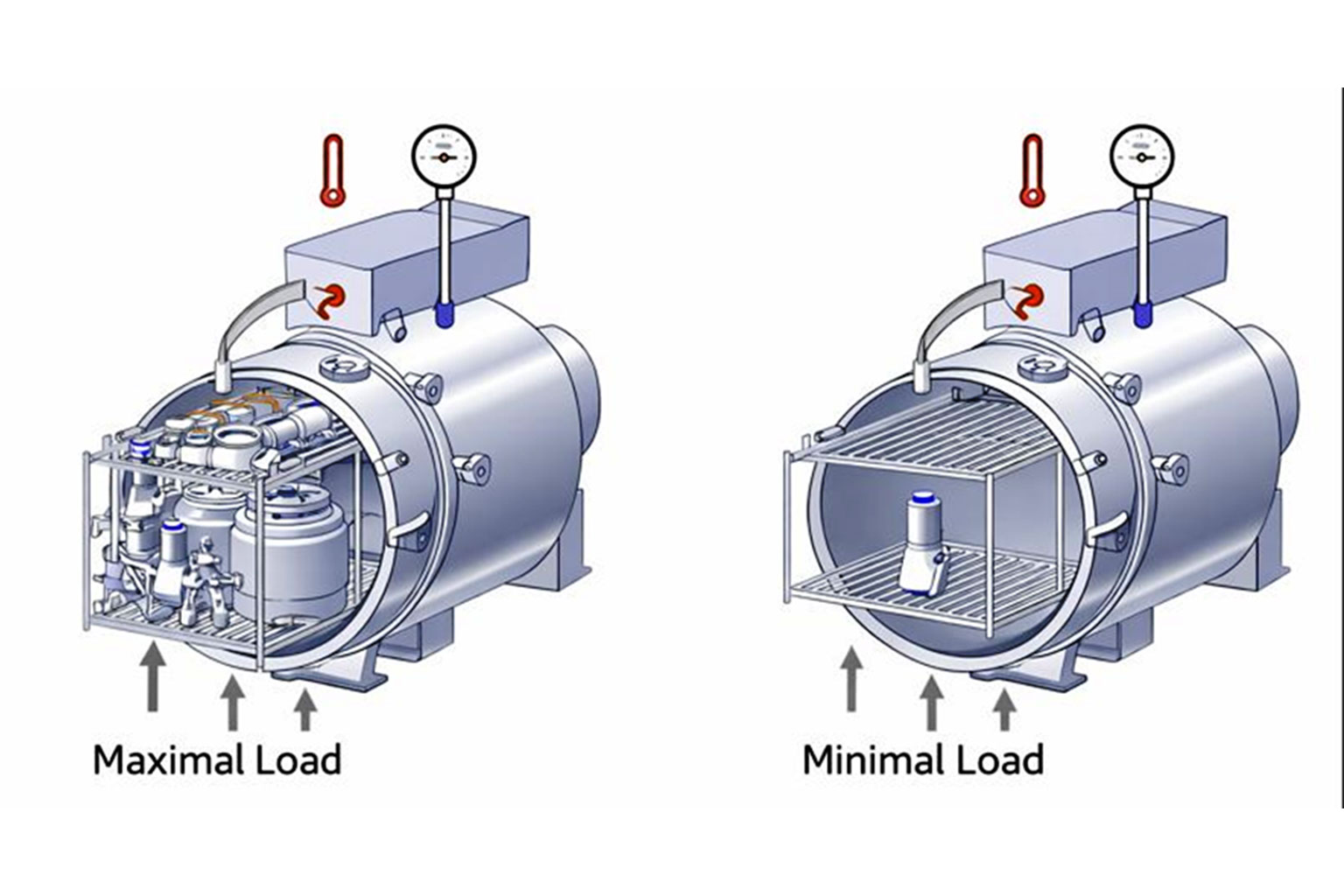
Annex 1 calls for a justified, risk-based load-validation strategy — not automatic validation of every maximum and minimum load. In high-lethality overkill cycles, dropping the minimum-load study is often the correct, compliant call.
What §8.38 actually says
EU GMP Annex 1, Section 8.38, states that validated loading patterns should be established for sterilization processes and that maximum and minimum loads should be considered as part of the overall load-validation strategy. Importantly, the guideline does not mandate that both extremes must be validated in every situation; rather, it calls for a justified, risk-based approach to determining which load configurations are truly critical.
Despite this, a prevailing assumption in industry is that regulatory expectations require validation of both maximum and minimum loads in all cases, regardless of the sterilization strategy or the actual risk profile.
How minimum loads are typically defined
The common approach begins with penetration studies in an autoclave chamber filled with all items required for the production activity — or with the maximum reasonably achievable load that does not create occluded areas where air removal and steam penetration are impaired. Thermal penetration results are then evaluated, and in most cases the item with the lowest lethality value (F₀) is considered the most challenging. That item is subsequently selected for the minimum-load penetration run.
In many respects, maximum loads present the greater challenge: they contain more items, can impede air removal and steam flow, and the wider variety of items in the validation provides more meaningful and representative data. So why is a minimum-load cycle required at all?
The two arguments for minimum-load studies
- Faster heating. The minimum load is expected to heat up more quickly, potentially producing shorter exposure at temperature compared with the maximum load.
- Faster air removal. With fewer items and fewer internal voids, air is evacuated more rapidly. Less time is available for air to escape from deep internal voids during vacuum pulses, and during steam pulses, the shortened exposure time may prevent steam from fully penetrating these voids.
The critical question: do these theoretical differences in heating and air removal have a meaningful impact on sterilization assurance — or is minimum-load validation an additional effort with limited practical value in an overkill steam sterilization strategy?
The overkill safety margin makes the difference
In overkill cycles delivering high lethality values — typically F₀ > 25 minutes — the sterilization margin is extremely large. Such cycles exceed the lethality required to achieve a SAL of 10⁻⁶ (F₀ = 12 minutes) by a very wide margin.
Because microbial destruction follows logarithmic kinetics, increases in lethality beyond this point produce orders-of-magnitude reductions in the probability of a non-sterile unit, far exceeding practical and regulatory requirements.
For example, with a conservative maximum D-value for typical bioburden of 0.5 minutes, increasing F₀ from 12 to 25 minutes shifts the sterility assurance level from 10⁻⁶ to approximately 10⁻³².
In many sterile manufacturing facilities, sterilization cycles of 25, 30, and even 40 minutes at temperatures in the range of 122–124 °C are routinely employed. These deliver lethality values well above 30 minutes, often exceeding 40 minutes. Yet this substantial excess lethality is often not explicitly recognised or leveraged. The assumption defaults back to: validate both extremes, every time.
Where the lowest lethality actually shows up
Experience and published data further show that, in many cases, the lowest lethality values are observed within maximal loads, not minimal loads. Validation results aggregated from six autoclaves — across different load configurations and air-removal processes — demonstrate that maximal loads, with more items and more potential obstructions, often define the lower bound of achieved lethality.
Source: Ben-David, A. (2023). Flexible Loading Pattern Approach in Overkill Steam Sterilization Based on the Physical Properties of Steam and Thermodynamics of Sterilization. PDA Journal of Pharmaceutical Science and Technology, 77(3), 166–180.
When cycle lethality is high, differences in the achieved F₀ between configurations are not operationally significant — even the lowest values still surpass by a substantial margin the lethality necessary to ensure a SAL of 10⁻⁶.
Air removal: a chamber-level concern, not a load extreme
The other critical factor is air-removal efficiency. When the air-removal process is correctly engineered and sufficient redundancy is built in, effective air removal and steam penetration can be maintained even when vacuum and steam pulses execute more rapidly. Air removal is a chamber-level function — its performance is not determined by whether the load is at the maximum or minimum extreme.
When minimum-load validation is not mandatory
Consider the overall validation strategy where:
- The sterilization cycle is an extended overkill cycle with lethality well above the minimum required value of 12 minutes
- Air-removal efficiency is demonstrated to be robust and appropriate for the load items
- The most challenging locations within the items are identified, included, and evaluated during validation
Under these conditions, a dedicated minimum-load validation cycle does not provide additional meaningful information or value. Performing minimum-load validation is not mandatory, provided the rationale is scientifically sound, risk-based, and appropriately documented.
Annex 1 encourages consideration, not automatic testing. Applying these considerations together with risk-based thinking allows a sterilization validation strategy that omits minimum-load validation — reducing validation burden, avoiding unnecessary loss of production time, and still maintaining patient safety while remaining fully compliant with Annex 1.

